The past few years have been turbulent, with staff turnover and the rise of remote work at an all-time high. Most companies will have noticed the impact of ‘The Great Resignation’, or had to make difficult redundancies in response to the pandemic and the cost-of-living crisis. With employees changing jobs more frequently, are you sure your employee leaver process is robust enough to combat the security risks that come with IT offboarding?
The likelihood is it’s probably not, which leaves your business exposed to potential cyber attacks and data breaches. And the numbers from research conducted by Beyond Identity are sobering:
Worse still, 56% say they’ve used that continued access to harm a former employer, turning a loose offboarding process into a direct business risk.
Picture this: one of your employees has handed in their notice. You get busy with the exit interview, collecting access cards, advertising the job, interviewing candidates, organising a leaving present. But have you ever thought about the technical side of employee offboarding?
Neglecting to properly remove former employees from accessing your systems and applications is where the major security issues with offboarding lie. So next time one of your team decides to pursue another opportunity, make sure your cyber security is front of mind, did they ever really enjoy team drinks anyway?
The major risks to your security when employees leave
Whether your employee leaves the company on bad terms or not, an unreliable leaver process can expose you to a number of IT security and financial risks that can end up damaging your reputation. Here are the major threats you face without secure employee IT offboarding:
What's at stake
-
Data breaches
A former employee with access to confidential data could sell it on the dark web or accidentally expose sensitive records.
-
Damage to your reputation
Disgruntled employees with access could abuse your brand, imagine a mass email going to all clients with harmful content.
-
Cyber-attacks
Ex-employees can sell company data or passwords for financial gain, leaving you vulnerable to professional cyber criminals.
-
Compliance violations
Regulators can issue substantial fines for breaching data-protection rules, financial loss plus loss of public trust.
The risks of an unreliable leaver process: a short case study
In 2018, Pagosa Springs Medical Center, a critical access hospital in Colorado, USA, found themselves at the centre of a serious HIPAA violation. A terminated employee was not properly offboarded, they retained remote access to the medical centre’s calendar system, which contained the confidential medical information of at least 557 individuals. The fine: $111,400.
HIPAA (The US Health Insurance Portability and Accountability Act) calls out the need for a formal offboarding process under the security rule section: “Implement procedures for terminating access to electronic protected health information when the employment of a workforce member ends.”
HIPAA is just one standard that can be violated due to improper offboarding. There are many similar regulations globally that carry similarly serious consequences for non-compliance.
Best practices for a seamless employee leaver process
So, you’ve heard how detrimental improper IT offboarding can be. But how exactly do you make sure your business is secure when employees leave?
The five pillars
-
Onboard correctly
Start with least-privilege access and a Privileged Access Management solution, what isn’t granted doesn’t need revoking.
-
Communicate with HR
Cross-departmental visibility on resignation, last day, return-from-leave and contract renewals.
-
Find the right identity partner
An IdP that supports automated deactivation, instant revocation, and easy re-activation.
-
Keep a list of technical assets
Laptops, monitors, mobile devices, headphones, USBs, software licences, domains, track every asset to every employee.
Your IT support provider should provide asset reporting for all desktops and laptops, along with recent employee login information which is a great start for the key devices you need to keep track of.
-
Recover and repurpose securely
Back up business data, then let Sereno IT wipe devices with NCSC-approved erasure software before redeploying them to new starters.
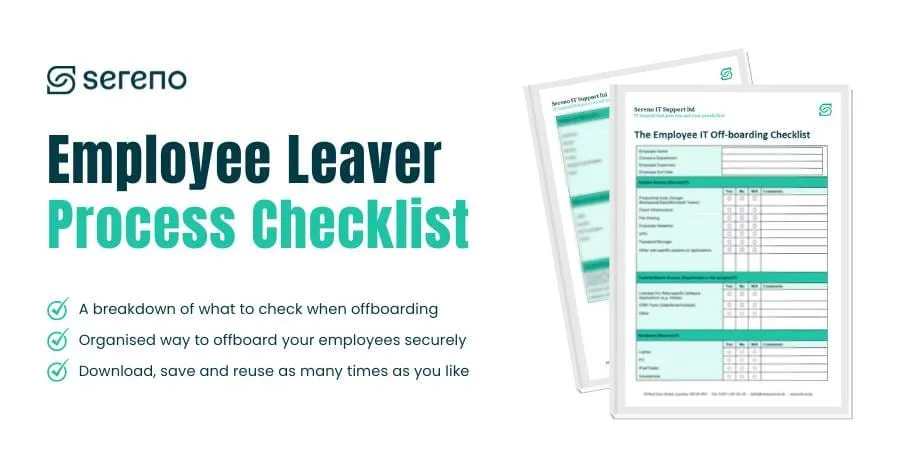
Your quick checklist for offboarding employees securely
There’s a lot to keep on top of when an employee leaves, and if multiple employees are leaving each month, that’s a lot of admin. So how do you keep on top of it all?
Use this checklist as a key step in your employee leaver process:
-
Track employee exit dates
Establish a routine for IT and HR to communicate clearly about exit dates. It ensures company-owned devices are returned and the departing employee has no access to company systems and sensitive data.
-
Block account access
Maintain a full list of systems the departing employee has access to, devices, applications, customer databases, cloud systems. Transfer ownership where needed. Block remote access and terminate VPN.
-
Revoke email access
The employee’s inbox likely contains critical contacts, valuable data, and sensitive files. Revoke email access on the last day. Wipe locally-synched emails from personal devices. Remove Teams and internal app accounts.
-
Update shared passwords
Sereno’s IT teams often see employees sharing accounts, we discourage this practice. If it’s happening in your organisation, rotate the passwords on every shared credential at departure.
-
Record IT assets
Draw up a list of IT assets and hardware linked to the leaver. Include laptops, PCs, mobile devices, peripherals, and user accounts (social media + job-specific).
-
Examine IT assets
A careful examination on return reveals damage or security risks. Remove sticky keys, deep-clean devices so they’re ready for the next user.
Secure employee IT offboarding with Sereno
So now you know all about what makes a secure employee leaver process, but how do you actually implement it?
That’s where we come in. At Sereno we’re obsessed with cyber security, meaning we’re here to offer you all the help and support you need to keep your systems secure when employees leave.
We remove 80% of the work involved with an employee leaving, so you don’t have to stress about disgruntled leavers or unwiped devices.
As with all aspects of our IT support model, we want to take away the burden and admin of IT processes, so you can focus on your day job.
Initial IT audit & your bespoke offboarding checklist
When we first bring you onboard as a new partner, we audit your entire IT environment. This enables us to learn everything we need to know about your systems, apps, and tools. Once we have this information, we create a thorough offboarding checklist customised to the needs and setup of your business, think: an advanced and personalised version of the checklist above, just for you.
Once created, we run through it with you to check everything’s covered and you’re comfortable with our responsibilities. After this, you shouldn’t see your offboarding checklist again, because now we’re responsible for checking every box.
Your employee offboarding form
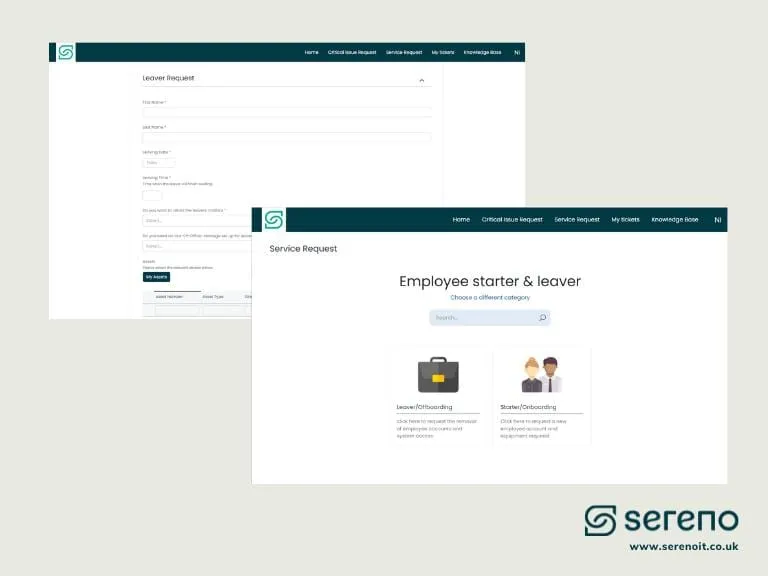
Now that we have the information, we create your employee offboarding form. Like your checklist, this is bespoke to you. The form lives in our Partner Portal and includes information specific to your setup and process, who’s leaving, when, where their mailbox is being redirected to, the status of their devices, etc.
Continually improving your leaver process
Whilst you’re partnered with us, we continually provide recommendations to keep improving security and efficiency. Examples include:
- Restricting employee permissions based on role, so they only ever have access to what they need
- Fully managing your assets, so you control how employees use their devices
- Centralised user profile management for fast revocation
- Single Sign-On (SSO) so revocation is one switch
- A password manager so shared credentials can be rotated instantly
- Remote device wiping so devices can be wiped wherever they are
Offboarding employees effectively is crucial to maintaining security and business continuity. The good news is you can trust Sereno with it. Our process means all you need to do is fill out one form and hand everything over to us. Our rigorous process and trained security engineers mean you can be sure employees are offboarded safely and punctually.
To find out more, or to switch your IT support company, please contact Sereno at 0203 089 01 41 or at hello@serenoit.co.uk.
Written by
Eric Ryan
Part of the Sereno IT team helping growing UK businesses make confident, jargon-free technology decisions. Read more business operations guidance in our Business Operations library.