If your business already uses a Managed Detection and Response (MDR) service or works with a Security Operations Centre (SOC), you’ve made a smart move. These services focus on real-time monitoring and response across your endpoint devices, such as laptops and desktops as well as platforms like Microsoft 365 and Google Workspace. That forms a critical foundation.
But even with those systems, a significant blind spot often remains.
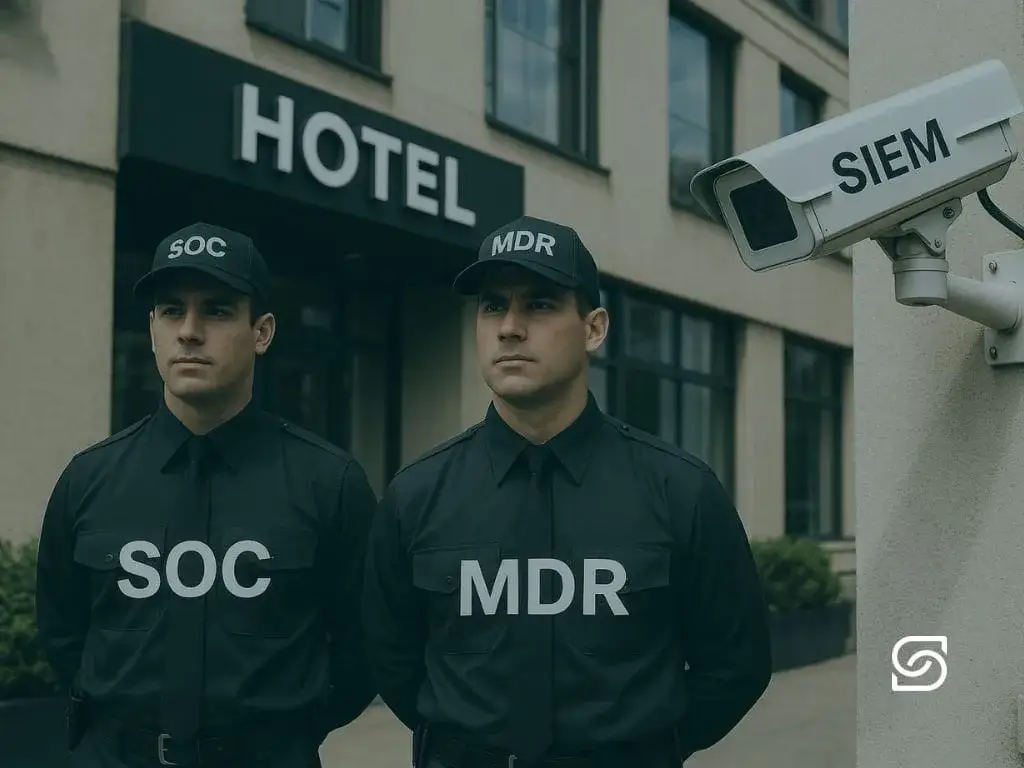
Think of it like this: MDR and SOC are the security guards in a hotel who patrol the corridors and respond when alarms sound. But what about the CCTV footage? The recordings that show what happened before, during, and after a break‑in? That’s where you learn how the threat entered, what it accessed, and how long it remained unnoticed.
That’s what a SIEM (Security Information and Event Management) brings to the table. Unlike MDR or SOC services, which actively monitor and respond to threats across endpoints and cloud platforms like Microsoft 365 and Google Workspace, SIEM takes it further. It doesn’t just react; it records, analyses, and correlates every event to give you the bigger picture.
It collects data from across your entire IT environment, analyses it over time, and connects seemingly unrelated events into a clear picture. That means you don’t just know that something happened. You understand how, when, where, and what it affected.
And the business case is strong. According to recent Forrester and Microsoft studies:
- Up to 88% faster incident response times, reducing operational downtime and reputational risk
- False positives cut by 79%, freeing up your team to focus on real issues
- Investigation time reduced by 85%, meaning less time spent chasing logs, and more time preventing actual threats
For business owners, that means fewer disruptions, stronger compliance, and a security investment that pays for itself, fast.
These aren’t projections. They’re proven outcomes from businesses already using SIEM. It’s the only solution that continuously collects and retains every system log and alert for a defined period, giving you a complete trail for compliance and incident investigation. Other services don’t store everything, which means losing the data that could have revealed what really happened.
Whether you’re protecting client trust, preparing for audits, or reducing your risk exposure, SIEM gives you visibility that delivers real returns.
If you’re serious about security you can prove and not just react to, it’s time to look at what SIEM adds to the equation. Read on to learn more.
What SIEM actually does (and why it matters)
SIEM (Security Information and Event Management) sounds like jargon, but don’t worry about the acronym. What matters is what it does for your business.
The concept of SIEM was formalised by Gartner in 2005, combining two earlier security disciplines: Security Information Management (SIM) for log storage, and Security Event Management (SEM) for real-time monitoring. Together, they created a system that could collect, analyse, and correlate security data across complex environments.
SIEM first emerged as a way for large organisations to centralise logs and make sense of growing volumes of security data. As attacks grew more sophisticated, affecting cloud platforms, endpoints, and networks. SIEM evolved from a niche compliance tool into a critical layer of modern cyber defence.
Today, it’s no longer just for enterprise IT teams. With the rise of cloud-native platforms and managed services, SIEM is now practical for businesses of all sizes that want clearer visibility, faster response times, and stronger audit readiness.
SIEM collects security data from across your IT environment, emails, devices, cloud platforms like Microsoft 365, firewalls and servers, and pulls it all into one place. It doesn’t just store that information; it makes it useful. Here’s how SIEM helps:
How SIEM helps
-
Spots hidden activity
A failed login on one system and unusual access on another might look unrelated. SIEM sees the connection and alerts you before it escalates.
-
Detailed records
If there’s a breach, SIEM shows exactly what happened, when and what was affected, retaining logs so you can trace incidents long after they occur.
-
The full story
While MDR reacts on the device and SOC handles live threats, SIEM correlates data across systems and time to connect the bigger picture.
It also plays a central role in proactive IT monitoring and support. Rather than reacting to problems as they happen, SIEM gives you the insight to spot patterns early, investigate unusual behaviour, and strengthen your defences over time. And because it works alongside your existing tools, it enhances your security without replacing anything.
How SIEM helps you stay compliant (and audit-ready)
Cybersecurity isn’t just about blocking threats, it’s also about proving you had the right protections in place when it mattered. That’s where SIEM truly adds value.
Whether you’re working toward a certification, operating in a regulated industry, or responding to client security questionnaires, it’s crucial to have a clear, consistent record of your IT activity. SIEM does this automatically, retaining logs and event data over time to meet compliance requirements and support detailed investigations after an incident. It gives you the traceability auditors expect and the visibility your team needs to strengthen defences.
Below is a breakdown of how SIEM aligns with widely recognised compliance frameworks:
| Compliance framework | Is SIEM required? | What SIEM helps you do |
|---|---|---|
| Cyber Essentials Plus | Recommended | Shows strong security practices with central logging and faster breach detection |
| ISO 27001 | Often needed | Supports log tracking, incident response, and passing audits more easily |
| FCA (Financial Conduct Authority) | Strongly expected | Helps meet financial regulations with real-time monitoring and audit-ready records |
| GDPR (UK) | Implied / recommended | Supports timely data breach reporting (within 72 hours) and tracks data access |
| NIS2 Directive (UK critical services) | Required for relevant businesses | Helps meet expected standards for cyber resilience and security visibility |
| CIS Controls (UK guidance) | Explicitly recommended | Meets Control 8 requirements: logging, correlation, and alerting |
| SOC 2 (US / international clients) | Recommended | Helps show trust, security, and accountability to clients outside the UK |
Even when SIEM isn’t explicitly required, it gives your business a measurable edge, improving visibility, accelerating investigations, and making compliance easier. It also adds depth to your business IT support, turning reactive setups into proactive, well-documented systems that are easier to manage, audit, and scale.
SIEM pricing explained (including 1-year log retention)
How is SIEM priced? SIEM pricing typically depends on the number and type of data sources being monitored. Each “source” represents a system or platform that generates logs and security events, the inputs your SIEM collects, analyses, and retains for review. Common source types include:
| Source type | Example | Purpose |
|---|---|---|
| Microsoft 365 account | Licensed user or shared mailbox | Captures user activity, access logs, and authentication events |
| Endpoint device | Laptop, desktop | Monitors system activity, login attempts, and local threats |
| Firewall | Hardware or cloud-based firewall | Tracks network traffic, intrusion attempts, and access patterns |
| Onsite server | Virtual machine or physical server | Records system logs, performance metrics, and access history |
| DUO / DNS Filter / Keeper | Company-wide access and security tools | Collects authentication, filtering, and access control data |
| Wireless access point | Cloud-managed WAP | Logs device connections and network behaviour |
What does 1-year log retention mean? Log retention refers to how long your system activity and alerts are securely stored. With a 1-year retention period, every relevant event, from login attempts to email access, is recorded and saved for 12 months. This makes it possible to trace security incidents weeks or months after they occur, supporting both compliance requirements and forensic investigations. Retention periods can also be extended (e.g. up to 7 years) for organisations in legal, financial, or other regulated industries that require long-term data visibility.
What does that investment give you?
- A clear view of activity across all your business tech
- A searchable record of system behaviour for audits or investigations
- Smart alerts that connect the dots across multiple systems
- Faster, more confident response when something suspicious happens
It’s a low monthly cost to help avoid high-stress surprises later, whether that’s a breach, a compliance review, or a client asking how secure your systems really are.
The bottom line
Modern threats aren’t always obvious. Sometimes they blend in, moving across tools and systems quietly, only becoming clear once the damage is done. That’s exactly why SIEM matters.
It gives you the visibility most businesses don’t have. You don’t just get alerts, you get clarity. You don’t just tick compliance boxes, you gain control.
If you’re already using MDR, you’ve got a solid start. SIEM builds on that, connecting the dots across your entire IT setup so nothing slips through unnoticed. If you want fewer surprises, quicker answers, and a clearer view of what’s really happening in your systems, SIEM is worth exploring.
Written by
Reymart David
Part of the Sereno IT team helping growing UK businesses make confident, jargon-free technology decisions. Read more cyber security guidance in our Cyber Security library.