The best IT support companies in London are not necessarily the biggest, oldest or cheapest. The right provider depends on your organisation’s size, security requirements, cloud environment, internal IT capability and how much responsibility you want an external partner to take.
Choosing an IT support company is about more than response times and monthly fees. Poorly managed IT can lead to recurring problems, security gaps, unnecessary downtime and internal teams spending too much time coordinating suppliers.
It examines their services, technical expertise, cybersecurity credentials, local presence and published service standards, helping you build a shortlist based on what your business actually needs.
London IT Support Companies at a Glance
The following table compares seven IT support companies in London, from smaller specialist providers to national managed service providers.
| IT Support Company | Best Suited To | Key Services | Location | Customer Rating |
|---|---|---|---|---|
| Sereno IT Support | Growing SMEs with 10 to 120 employees seeking proactive IT management | Managed and co-managed IT, cybersecurity, Microsoft 365, Google Workspace | Holborn, London | 5.0/5 (70+ Google reviews) |
| totality services | London SMEs wanting outsourced IT support | Managed IT, cybersecurity, Microsoft 365, Google Workspace | Vauxhall, London | 4.9/5 (44 Google reviews) |
| NetMonkeys | Organisations requiring ERP implementation, bespoke software development and IT support | Managed IT, cybersecurity, cloud, disaster recovery | Kensington, London | 5.0/5 (1 Clutch review) |
| T-Tech | Professional services firms and internal IT teams | Managed and co-managed IT, cybersecurity, consultancy | Islington, London | 4.7/5 (12 Google reviews) |
| HTL Support | Businesses needing infrastructure and cloud support | IT support, networking, cloud, cybersecurity | Canary Wharf, London | 5.0/5 (25 Google reviews) |
| Littlefish Group | Larger organisations and enterprise environments | Outsourced IT, service desk, cybersecurity, cloud | Central London | 4.9/5 (23 Cloudtango reviews) |
| Akita | Mid-sized businesses requiring comprehensive IT services and consultancy | Managed IT, cybersecurity, cloud services, Microsoft solutions, IT consultancy | City of London | 5.0/5 (14 Google reviews) |
The suggested business fit is an editorial assessment, not a formal ranking.
What to Look for When Comparing IT Support Companies
The best provider is not necessarily the one offering the broadest range of support services. It is the one that can manage your requirements effectively, with clear responsibilities and measurable service standards.
Fully Managed vs Co-Managed IT Support
Fully managed IT support means an external provider takes responsibility for agreed areas of your IT environment, including helpdesk support, devices, cloud platforms, security and ongoing administration.
This typically suits SMEs without an internal IT department.
Co-managed IT support involves an external provider working alongside an internal IT team, supplying additional capacity or specialist expertise.
For example, an internal IT manager might oversee business applications while a support partner manages Microsoft 365, endpoint security and day-to-day support.
Neither model is automatically better. The important point is defining who owns each responsibility so that problems do not fall between teams.
Technical Expertise and Industry Experience
Technical expertise should extend beyond troubleshooting individual issues.
Modern businesses rely on interconnected systems, including Microsoft 365, Google Workspace, cloud applications, devices and identity platforms.
A provider with deep technical expertise will investigate underlying causes rather than repeatedly applying temporary fixes.
Industry experience also matters. An accountancy practice, financial services firm or creative agency may have very different applications, compliance requirements and operational priorities.
Ask whether the provider regularly supports businesses with similar systems and requirements.
Response Times, Resolution Times and SLAs
A fast response does not necessarily mean a fast resolution, and neither guarantees a good support experience.
Response time measures how quickly a provider acknowledges or begins handling a request. Resolution time measures how long it takes to restore service or resolve the issue.
A provider could respond within five minutes but leave an employee unable to work for several hours.
When reviewing service level agreements (SLAs), ask how incidents are prioritised, escalated and communicated. Also consider whether the provider measures customer experience alongside technical performance.
A strong support agreement should include clear response and resolution targets, as well as metrics for communication, service quality and customer satisfaction.
The goal is measurable accountability for both resolving problems and delivering a positive support experience.
Cybersecurity Capabilities
Cybersecurity should be part of everyday IT management, not an optional service considered only after an incident.
The UK Government’s Cyber Security Breaches Survey 2025/2026 found that 43% of UK businesses identified a cyber breach or attack during the previous 12 months. The figure was 46% for small businesses and 65% for medium-sized businesses.
When assessing cyber security services, ask about endpoint protection, multi-factor authentication, Microsoft 365 security, access management, backups, security awareness training, and incident response.
Cyber Essentials Plus independently tests essential cybersecurity controls, while ISO 27001 focuses on information security management.
Assurix Trusted MSP goes further, assessing the security and operational practices of managed service providers, including incident response, backup recovery and service delivery.
When comparing providers, these credentials offer independent evidence of their security standards, operational maturity and commitment to managing IT responsibly.
Scalability and Proactive IT Management
Your IT support should evolve as your business grows.
Processes that work for 10 employees may become unreliable at 50. New starters wait for access, devices become inconsistent, licences accumulate and security permissions become difficult to manage.
Proactive managed IT services should address these issues before they cause repeated support requests.
Look for providers that standardise onboarding, offboarding, device management, monitoring and technology planning.
The goal is to minimise downtime and align IT infrastructure with business goals, rather than simply fixing problems after they occur.
Pricing and Contract Terms
IT support may be charged per user, per device or through a fixed monthly agreement.
Comparing headline prices alone can therefore be misleading.
Check what support packages include, particularly cybersecurity, Microsoft 365 administration, backups and maintenance. Also identify additional charges for projects, hardware and out-of-hours support.
On-site support is worth reconsidering. With most issues resolved remotely, paying for routine on-site visits may offer little value. Ask whether you can arrange visits when genuinely needed, rather than paying for them by default.
A transparent support agreement should explain what is included, what remains your responsibility and how costs change as the business grows.
Reviews and Customer References
Reviews provide useful insight into communication, reliability and customer experience.
Look beyond star ratings. Comments about recurring issues being resolved, clear communication and proactive guidance can reveal more than general praise for friendly engineers.
Ask shortlisted providers for customer references from organisations with similar requirements.
A dependable IT support company should be able to demonstrate consistent service after the sales process ends.
7 IT Support Companies to Consider in London
These seven providers offer different combinations of managed IT support, cybersecurity, cloud management and consultancy. Their published capabilities provide a useful starting point for comparison.
Sereno IT Support
Sereno IT Support supports growing London SMEs through fully managed and co-managed IT services.
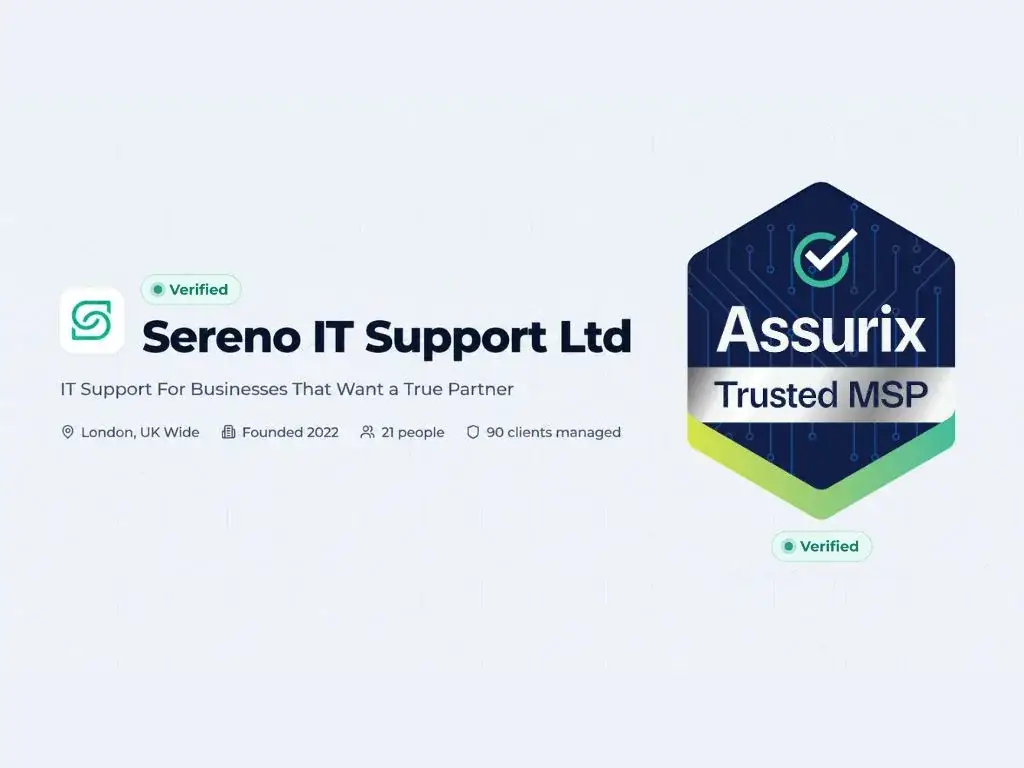
Supporting 75+ businesses and 2,300 users, Sereno works with 15+ technology vendors and holds Microsoft, Google, Cyber Essentials Plus and Assurix Trusted MSP credentials, alongside industry awards such as SME London Business Awards 2026 and Cloudtango MSP Select UK 2026.
Sereno stands out through its Customer Experience Agreement (CXA), which measures support quality beyond SLAs, and quarterly Technology Reviews assessing 100+ IT factors to identify risks and improvements.
Best suited to: Growing SMEs with 10 to 120 employees wanting a local IT partner that combines responsive support with proactive management and clear accountability.
totality services
totality services is a London-focused IT support provider offering managed IT, cybersecurity, consultancy, Microsoft 365 and Google Workspace services.
It advertises 24/7 remote support and publishes an average ticket resolution time of 6.5 minutes.
Its stated credentials include ISO 27001, ISO 9001 and Microsoft Solutions Partner status.
Best suited to: Organisations in legal sector requiring specialist industry support and round-the-clock IT coverage.
NetMonkeys
NetMonkeys offers managed IT support, cybersecurity, Microsoft 365, cloud management and disaster recovery.
Its Kensington office provides a London presence alongside wider UK operations.
NetMonkeys publishes a 15-minute response SLA and states that Zone 1 on-site assistance is typically available within 90 minutes.
Its website also lists Cyber Essentials Plus and Microsoft Solutions Partner credentials.
Best suited to: Organisations requiring specialist ERP implementation, bespoke software development and IT support across multiple UK locations.
T-Tech
T-Tech provides fully managed and co-managed IT services, cybersecurity, consultancy, automation and Microsoft cloud solutions.
It has a particular focus on professional services organisations, including accountancy and asset management firms.
Its published credentials include Microsoft Solutions Partner and Cyber Essentials Plus.
Best suited to: Professional services businesses and organisations with internal IT teams requiring specialist support.
HTL Support
HTL Support is a Canary Wharf-based IT provider offering managed support, infrastructure, cloud services, networking and cybersecurity.
Its published certifications include ISO 9001 and ISO 27001.
HTL’s offering combines traditional infrastructure management with cloud, backup, disaster recovery and business continuity services.
Best suited to: London businesses requiring managed infrastructure, networking and cloud support alongside everyday IT services.
Littlefish Group
Littlefish Group provides outsourced IT operations, service desk support, cybersecurity, infrastructure management and Microsoft services.
Its offering targets larger mid-market, enterprise and public sector organisations.
Littlefish publishes service desk metrics including sub-10-second average response times and more than 95% first-contact resolution.
Its security credentials include Cyber Essentials Plus, ISO 27001 and CREST-accredited operations.
Best suited to: Larger organisations with an estimated 250 to 5,000+ employees, requiring structured service management and complex IT operations.
Akita
Akita provides managed IT support, cybersecurity, cloud services, Microsoft solutions and IT consultancy to businesses across the UK.
Its services range from fully managed and co-managed IT support to infrastructure management, business applications and digital transformation.
Akita offers a broad range of technical expertise, making it particularly relevant to organisations looking for a provider that can support both everyday IT operations and more complex technology projects.
Best suited to: Mid-sized businesses requiring comprehensive IT services and consultancy.
Disclaimer: Information is based on our research. For specific requirements or the latest details, please contact the companies directly.
What Makes Sereno IT Support a Strong Choice for London Businesses
For growing SMEs with 10 to 120 employees, Sereno’s main differentiator is its emphasis on IT ownership rather than reactive ticket handling.
Its service combines local support, Microsoft and Google expertise, cybersecurity and proactive technology management.
With specialist expertise across professional services, finance and property, Sereno focuses on identifying and eliminating the root causes of recurring IT issues rather than repeatedly applying temporary fixes.
Response, Resolution and Customer Experience
Sereno publishes separate response and resolution targets, helping clients understand what to expect when different types of incidents occur.
It also uses a Customer Experience Agreement, or CXA, alongside its service commitments.
This places additional emphasis on communication, accountability and the overall support experience, rather than measuring service performance through ticket response times alone.
Published Service Metrics
Sereno’s published service measures include:
| Service Measure | Published Figure | What It Means for Clients |
|---|---|---|
| Customer satisfaction | 98% | Your team gets support that customers consistently rate positively. |
| Requests resolved the same day | 76% | Get most IT issues resolved the same day, keeping your team productive. |
| Average SLA adherence | 90% | Count on support measured against clear response and resolution commitments. |
| Quarterly CXA minimum | 95%+ | We aim for 95%+ customer satisfaction. If we fall short, we improve, or you’re free to leave. |
These figures provide useful transparency, although businesses should always ask how metrics are calculated and reported.
Quarterly Technology Reviews
Sereno’s quarterly Technology Reviews assess more than 100 factors across cybersecurity, infrastructure, devices, backups, licensing and compliance.
The findings are used to prioritise improvements and plan future technology requirements.
For example, a review may identify unnecessary Microsoft 365 licences, devices approaching replacement, inconsistent access controls or backup procedures that need further testing.
This proactive approach helps businesses stay ahead of problems instead of waiting for employees to report them.
Microsoft, Google and External Recognition
Sereno’s Microsoft Solutions Partner and Google Workspace Partner credentials support its work managing modern cloud environments.
The company also lists Cyber Essentials Plus and Assurix Trusted MSP status.
Sereno was the Silver Winner for High Growth Business of the Year at the SME London Business Awards 2026 and was included in Cloudtango’s 2026 UK MSP Select list.
These credentials offer additional evidence, although service performance and customer references remain important when evaluating any provider.
What Sereno Clients Say About Their IT Support
Customer reviews are particularly useful when they explain how a provider handles everyday support, communication and ongoing IT management.
Proactive IT Management
“Sereno have been a reliable and valued partner, with a fantastic team of highly responsive and capable technicians, backed by proactive and forward-thinking leadership.” John Holmes IT Manager, Oikos Storage Ltd Cloudtango Review
A Better IT Experience
“After a couple of challenging years with our previous IT support company, moving to Sereno IT in 2024 has been one of the best business decisions we’ve made.” Joanna Socko Franklyn James Cloudtango Review
Less Time Managing IT
“IT is no longer a burden or even a part of my work week.” Jamie Waldegrave COO/CFO, Urban Logistics Excerpt from Cloudtango Review
Sereno displays a 5.0 Google rating on its website, with feedback relating to responsive support, technical projects and customer service.
The most useful indicators are whether employees receive clear updates, recurring issues are addressed and the provider offers proactive guidance rather than waiting for problems to occur.
Businesses considering Sereno can review the customer feedback published on its website and request references from organisations with similar requirements.
Considering switching IT support providers?
Read Sereno’s guide: Changing IT Providers Is Easier Than You Think.
19 Questions to Ask Before Choosing an IT Support Provider
Before signing a support agreement, ask questions that reveal how the provider actually operates.
Service Performance and SLAs
- What is your average first response time?
- Do you publish resolution targets as well as response targets?
- How are incidents prioritised and escalated?
- What happens when an SLA is missed?
- Do you have any metrics to measure customer satisfaction with support, beyond response time SLAs?
Cybersecurity
- Which cybersecurity controls are included in the monthly fee?
- Are you Cyber Essentials Plus certified?
- How do you secure Microsoft 365, Google Workspace and user devices?
- Do you provide security awareness training and security monitoring?
- If we want to achieve Cyber Essentials or Cyber Essentials Plus certification in the future, how would you help us prepare, address security gaps and achieve certification?
Support, Costs and Responsibilities
- Are remote and on-site support included?
- What additional project or out-of-hours charges apply?
- How do you work with internal IT teams and other suppliers?
- Who owns a ticket through to resolution?
IT Management and Business Continuity
- How do you manage onboarding, offboarding and permissions?
- How frequently are backups and recovery procedures tested?
- What proactive monitoring and strategic reviews are included?
- How will services and pricing change as we grow?
- Can we speak with a customer with similar requirements?
A strong provider should explain the processes behind its answers, rather than relying on general promises of exceptional service.
Choosing the Right IT Support Company for Your Business
There is no single best IT support company in London for every organisation.
A 20-person business outsourcing IT for the first time will have different requirements from an organisation with several offices and an established internal technology team.
Start by assessing your business size, technical complexity, cybersecurity requirements, cloud environment and existing IT resources.
Consider whether you need fully managed support, co-managed services or specialist technical assistance.
Also establish which systems are business-critical, how much downtime you can tolerate and whether local on-site support is necessary.
The right IT support provider should offer clear ownership, suitable service level agreements, transparent pricing and the technical expertise to support your business as it grows.
Frequently Asked Questions
What Should You Look for in an IT Support Company
Look for technical expertise, reliable response and resolution SLAs, cybersecurity capabilities, transparent pricing, proactive management and relevant customer references. The provider should clearly explain its responsibilities and how it measures service quality.
How Much Does Business IT Support Cost?
IT support costs depend on employee numbers, devices, infrastructure, cybersecurity requirements and service coverage. Providers may charge per user, per device or through a fixed monthly fee. Compare the services included rather than headline prices alone.
What Is the Difference Between Fully Managed and Co-Managed IT Support?
Fully managed IT places agreed operational responsibilities with an external provider. Co-managed IT divides responsibilities between the provider and an internal IT team, providing additional capacity or specialist expertise.
Should IT Support and Cybersecurity Be Managed by the Same Provider?
Managing both together can reduce gaps between everyday IT operations and security controls. Separate providers can also work effectively when responsibilities, monitoring and incident escalation are clearly defined.
Do Businesses Need On-Site IT Support?
Many issues can be resolved remotely. However, businesses with networking equipment, physical infrastructure or specialist hardware should confirm that on-site assistance is available when required.
Is Cyber Essentials Plus Important When Choosing an IT Provider?
Cyber Essentials Plus provides independent technical verification of defined security controls. It is useful evidence, but should be considered alongside the provider’s wider security capabilities, operational processes and service performance.
How Should You Compare IT Support SLAs?
Compare response and resolution targets, incident priorities, service hours, escalation procedures and communication requirements. Also consider how recurring problems and customer satisfaction are measured.
Finding the Right IT Support Partner for Your Business
The best IT support services do more than resolve technical problems. They keep systems secure, reduce operational disruption and make IT easier for businesses to manage.
For growing London businesses, the right support partner should take responsibility for users, devices, cloud platforms, cybersecurity and ongoing improvements, with clear communication and measurable performance.
Sereno IT Support combines these capabilities through managed and co-managed IT services, Microsoft and Google expertise, published service measures and proactive Technology Reviews.
Want to understand whether your current IT support is meeting your business needs?
Contact Sereno IT Support to discuss your IT environment, current challenges and what a more proactive support arrangement could look like.
Written by
Paul Yadao
Marketing Executive
Part of the Sereno IT team helping growing UK businesses make confident, jargon-free technology decisions. Read more managed it support guidance in our Managed IT Support library.